Google Sniper

Monday, 27 February 2017

What is Parkinson's?

Parkinson's is a progressive neurological condition.
People with Parkinson's don't have enough of a chemical called dopamine because some nerve cells in their brain have died.
"Once I accepted myself as a person with Parkinson's, and did not think of myself as a lesser person because of this, other people did the same. It is not the most important thing about me".
Caroline, diagnosed in 2003
Without dopamine people can find that their movements become slower so it takes longer to do things.
The loss of nerve cells in the brain causes the symptoms of Parkinson's to appear.
There's currently no cure for Parkinson's and we don't yet know why people get the condition.
Parkinson's doesn't directly cause people to die, but symptoms do get worse over time.

How many people have Parkinson's?

One person in every 500 has Parkinson's. That's about 127,000 people in the UK.
Most people who get Parkinson's are aged 50 or over but younger people can get it too.

Parkinson's symptoms

Everyone with Parkinson's has different symptoms.
The main symptoms of Parkinson's are tremor, rigidity and slowness of movement.
As well as affecting movement, people with Parkinson's can find that other issues, such as tiredness, pain, depression and constipation, can have an impact on their day-to-day lives.
Symptoms and the speed at which the condition develops will differ from one person to the next.
The symptoms can be controlled using a combination of drugs, therapies and occasionally surgery.
Find out more about all Parkinson's symptoms.
As Parkinson's progresses, an increased amount of care and support may be required, although many people maintain a good quality of life with limited care or treatment.

Parkinson's diagnosis

"The Parkinson's nurse was immensely helpful – coming to my house when I was newly diagnosed and explaining Parkinson's to me so well".
Diana, diagnosed in 2004
It's not easy to diagnose Parkinson's. There are no laboratory tests so it's important that the diagnosis is made by a specialist.
The specialist will examine the person for any physical signs of Parkinson's and take a detailed history of the symptoms they're experiencing.
Find out more in our Diagnosing Parkinson's information sheet.
There are guidelines for the diagnosis of Parkinson's which health professionals should follow:
  • NICE Guideline (England, Wales, Northern Ireland)
  • SIGN (Scottish Intercollegiate Guidelines Network) Guideline

Source: https://www.parkinsons.org.uk/content/what-parkinsons

Friday, 17 February 2017

A ‘Hand-up, not a Hand-out’

ABF The Soldiers’ Charity is the National Charity of the British Army, offering a lifetime of support to soldiers, veterans and their immediate families when in need. Our priorities are to help these individuals by making grants to them through the Regimental and Corps Associations, and to support a wide range of specialist charities that sustain the British Army ‘family’, both at home and around the world.
Our mantra is that we provide “A hand up, not a hand out”. Whilst this term has become somewhat clichéd, none is more apt than President John F Kennedy’s use of the term (in 1961),  defining it as “doing something towards becoming self-sustaining” – this is exactly how we see it today.
Each year, on our collective behalf, we provide grants, funding and practical support to up to 100 third-sector organisations.

Some of the areas in which we help

Army Family

We are committed to supporting soldiers, veterans and their immediate families in times of need. This can include emergency flights across the globe following the death of a close family member in complex circumstances, to providing respite breaks for a young serving family dealing with the traumatic changes caused by an injury sustained on operations, or helping to buy highly-specialised equipment for a disabled child returning home following a stay in hospital.

Education and Training

Leaving the Army after injury can be a daunting experience. Subject to need, our grants have helped to provide equipment, courses and travel costs for those discharged from the Army on medical grounds and now looking for a new career path. This retraining covers practical courses like HGV licences, or vocational training like nursing.

Elderly Care

Maintaining dignity and independence for our veterans and their immediate families in need remains one of the most significant areas of our work. Recent grants have enabled an elderly veteran to remain in their own home with the aid of a stair lift, and another was able to maintain their independence thanks to a bathroom adaptation.  Other grants might include boiler repairs or care-home fees. Often speed is of the essence in providing such support.

Housing

The housing needs for veterans are incredibly varied. Our grants may help a homeless veteran who has no support network outside the Army to be able to move into a new property, or ensure that a young soldier on being made redundant has a house that is fit for his family to live in by providing carpets and essential furnishings, or to prevent eviction for a veteran who has fallen into rent arrears following a period of unemployment.

Mobility

Our mobility grants range from those for the very young to the elderly. We have provided grants for specialist play equipment for disabled children, and for electric mobility vehicles and specialist wheelchairs, particularly for the wounded injured and sick allowing participation in an array of sports.

Well-being

We have provided support to those with a variety of mental health issues. This has included the provision of counselling for a family dealing with bereavement or attendance on specialist courses to assist in building self-confidence and reducing anxiety.  We have also provided respite breaks for those dealing with the effects of mental health issues, so families can come together in a new environment.

Employment

Finding civilian employment on discharge from the Army can be difficult enough, without adding the extra challenge of an injury or illness.   With this in mind our charity has provided more than £1.8m over the last 3 years to fund Specialist Employment Consultants based throughout the country at the Army Personal Recovery Units.   The enormous success of this project, delivering successful outcomes for those being medically discharged has now ensured that these posts are funded by the MOD.
That said, our charity continues to proactively engage in employment related projects via our network of reliable partners who can effectively deliver successful outcomes for our beneficiaries by assisting and finding employment opportunities.   As an extension of our previous work with the RFEA and the SEC model, our Charity are now working with them to provide specialist vocational case-working help to Wounded Injured and Sick Veterans rather than those currently in transition.   This project will assist those WIS veterans who, through no fault of their own, now face substantial obstacles to employment and are no longer eligible for Career Transition Partnership resettlement package.

Source: https://www.soldierscharity.org/need-our-help/how-we-help/?gclid=CMKhkdDZl9ICFUkQ0wodEqkG9A#

Friday, 3 February 2017

Anxiety and depression twice as prevalent in military - study says

Members of the UK armed forces are twice as likely to develop depression or anxiety than members of the general working population, a study suggests.
The King's College London research compared surveys from 7,000 military personnel with people in other jobs.
It found 18% of men and 25% of women in the forces reported symptoms of common mental disorders, compared with 8% of men and 12% of women in other areas.
The MoD said it had improved mental health services for the military.
The researchers said the study, published in Psychological Medicine, was fairer then previous studies which included results from unemployed people and those with long-term health problems and disabilities - who researchers said were more likely to report symptoms of mental illness.
The findings could be explained by the frequency and intensity of stressful events experienced by those in the military, researchers said.
Military life also required extended periods spent away from family and friends, they added.
The survey included questions such as whether the subject felt they were "playing a useful part in things".
Respondents from the military were almost three times more likely to disagree with this statement than those from the general population, the study found.

Treatment needed

Lead author Dr Laura Goodwin said: "The findings were not what we expected. We didn't think there would be such a difference between members of the military and the rest of the general population.
"We know that other studies which recruit people just because they are in a particular occupation, such as teaching or social work, also find higher reports of anxiety and depression."
Prof Nicola Fear, from the King's Centre for Military Health Research, said: "This [report] highlights that symptoms of depression and anxiety are common in the armed forces. In fact, they are more common than alcohol misuse or post-traumatic stress disorder (PTSD).
"The findings draw attention to the need for Defence Medical Services to continue to focus on identifying and treating depression and anxiety in addition to PTSD."
Elsewhere, mental health charity, Combat Stress, said there had been a significant increase in the number of UK veterans of the Afghanistan conflict seeking help. It said it had received 358 new veteran referrals in 2013, a 57% rise on 2012.

'Support available'

The Ministry of Defence said it took the the mental health and wellbeing of personnel very seriously.
A spokeswoman said: "The government has long recognised that service life can cause stress.
"Since 2008, the last data used in this study, the MoD has made a number of improvements to the mental health services available to the armed forces.
"These include pre and post-operational stress management briefings, decompression, Trauma Risk Management, and the Big White Wall online wellbeing service.
"In addition, the MoD has introduced several anti-stigma campaigns to encourage serving personnel who need help to come forward to access the wide range of support that is available."

Source:  https://www.blogger.com/blogger.g?blogID=4592506238738253894#editor/target=post;postID=1213585181303181409

Monday, 30 January 2017

Understanding Depression - What treatments are available?

Antidepressants

Antidepressants work on chemical messengers in the brain to lift your mood. The usual recommendation is that you stay on them for six months. There can be some unpleasant side effects, which are worse to begin with.
Of the various different types available, SSRIs (selective serotonin reuptake inhibitors) are usually better tolerated.
When coming off anti-depressants, it is important to reduce the dose slowly over a period of weeks to avoid withdrawal symptoms.

Psychological treatments

Counselling can be short or long-term. It involves talking with someone who is trained to listen with empathy while you express your feelings and find your own solutions to your problems.

Cognitive Behaviour Therapy (CBT)

Identifies and helps change negative feelings affecting behaviour and may last up to 12 months.

Interpersonal Psychotherapy (IPT)

Focuses on relationships. Therapy often continues for six to 12 months.

Psychodynamic counselling/Physchotherapy

Psychodynamic counselling or psychotherapy focuses on how past experiences may be contributing to experiences and feelings in the present.
Psychotherapy is not usually available on the NHS. It is more frequent and intensive than counselling. For lists of qualified and regulated therapists, visit the British Association for Counselling and Psychotherapy at www.bacp.co.uk.

Source:  http://www.retailtrust.org.uk/services/retailhub/emotional-support/understanding-depression/available-treatments

Sunday, 22 January 2017

Trigeminal Neuralgia Support

When dealing with Trigeminal Neuralgia (TN), patients often suffer from debilitating pain that can inhibit them from enjoying everyday activities. In an effort to find cures and help patients suffering from TN, The Facial Pain Association (FPA) provides numerous pages of information, support, and discussions on our website. We urge patients and doctors to explore the website to learn more about TN.
Patients not only need a cure, they need support. To help patients cope with Trigeminal Neuralgia and other facial pain, encourage them to consider some coping options below:
  1.       Join an online support group. TNA Facial Pain Network offers an online community for those who are involved with Trigeminal Neuralgia in some way. On this website, patients can access chat rooms, discussion boards, events, videos, photos, TN information, and much more. This community is not limited to patients suffering from TN. Supporters of those with TN and others who are eager to encourage patients are welcome to join.
  2.       Make a list of all the positive aspects in your life. Avoid thinking about the pain and concentrate on things that make you feel better. Add photos of family and friends, write quotes from loved ones, or list your favorite songs to listen to when you are feeling down. Positivity can help cope with pain.
  3.       Keep a diary of your experiences. Not only can this help your doctor, this can help you, as well. Keeping track of your experiences and pain from Trigeminal Neuralgia will enable you to understand the pain. You can determine what triggers the pain, what helped relieve the pain, and the intensity level of the pain.
  4.       Practice healthy habits. This should be incorporated to your routine regardless of if you experience TN. Be sure to get adequate amount of rest, eat healthy, and exercise as often as possible. Your doctor can help you determine which exercises are safe. Keep a food diary to figure out which foods trigger pain. (Protein shakes are a great option because it does not require a lot of chewing.)
  5.       Research TN and the treatment options. Understanding the disease and options for treatment can help patients during the coping process. The FPA website provides a lot of information to educate all interested in understanding TN.
For more information regarding Trigeminal Neuralgia and online support, please click here!

Source:  http://fpa-support.org/trigeminal-neuralgia-support/?gclid=Cj0KEQiAzZHEBRD0ivi9_pDzgYMBEiQAtvxt-B_FL6_ck5Jeq3pPlQNBjAmm2LaTM5wXT43Nn5fmO80aAvNJ8P8HAQ

Monday, 16 January 2017

Reducing Anxiety & Overcoming Depression

Transcendental Meditation: an evidenced-based approach

How Transcendental Meditation reduces anxiety and depression. Scientific studies have shown that during TM practice, cortisol and other stress indicators fall markedly, blood pressure tends toward normal, the whole physiology shifts toward more settled and balanced functioning. This reversal of the stress response in the body results in a clearer, calmer, more harmonious state of mind and emotions outside of meditation.

Holistic Technique

Forty years of scientific research on Transcendental Meditation has identified a wide range of positive effects from regular, twice-daily practice. This research shows how TM impacts all aspects of mental and physical health - facilitating healing while promoting holistic growth and transformation.

Scientific studies

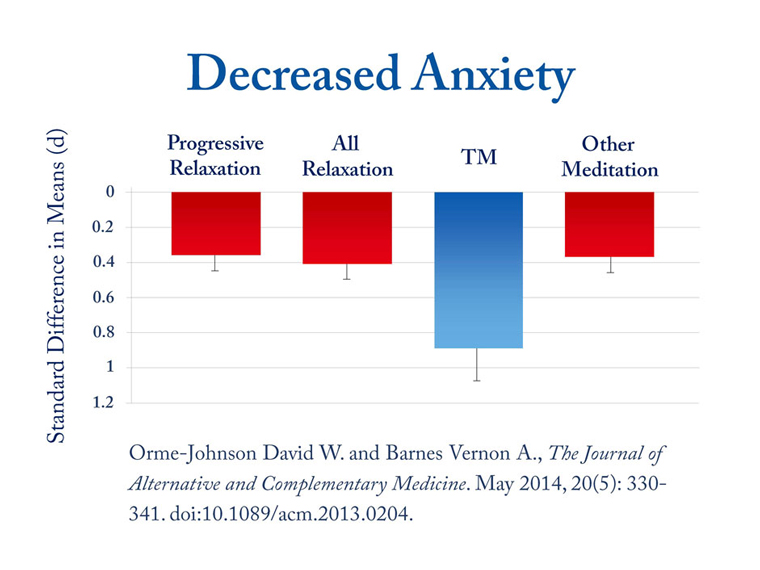
Decreased Anxiety

A comparative study, involving 1,295 subjects, found the TM technique more effective than other approaches at reducing anxiety. The study also found that TM practice significantly lowers anxiety among people with the highest measures of trait anxiety. Journal of Alternative and Complementary Medicine. May 2014, 20(5): 330-341.
Transcendental Meditation is more effective than other approaches at reducing anxiety

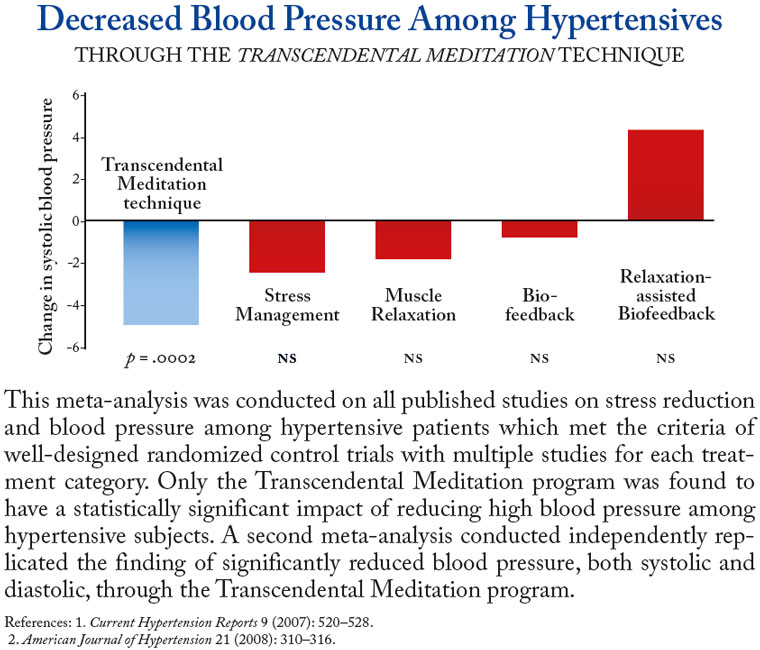
Normalization of High Blood Pressure

A meta-analysis conducted at the University of Kentucky considered a wide variety of meditation practices and found TM to be the only technique to significantly reduce high blood pressure. American Journal of Hypertension 21 (3): 310-6, 2008.
Transcendental Meditation found to be the only technique to significantly reduce high blood pressure

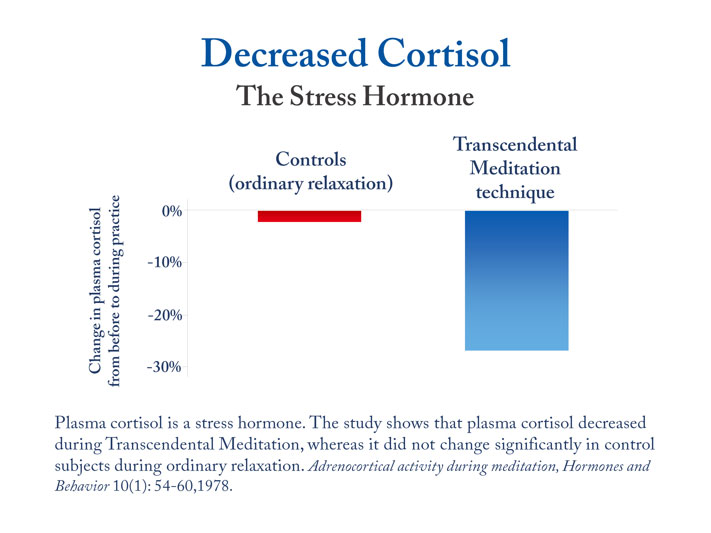
Biochemistry of Reduced Stress: Reduced Plasma Cortisol

Significantly decreased plasma levels of cortisol are seen during TM practice, indicating reduced stress in the physiology. Hormones and Behavior 10: 54–60, 1978.
Source: http://uk.tm.org/web/lp-anxiety/reduced-anxiety?leadsource=CRM1784&gclid=CJ_-gsbjxtECFUM6Gwodzo0H2w
 

Tuesday, 6 December 2016

Coping with the Ups and Downs of the Holiday Season

Ideally, the holiday season should be a time for good cheer. But for many, it is also a time for loneliness, sadness, anxiety, depression, and family conflict. Frequently people feel a profound sense of relief once the holidays are over. It's a bit ironic that we should look forward to the end of this season, when it could be a time for celebration, thanksgiving, and family reunion. Here are eight things you can do to make this a better holiday season for you and those around you:

1. De-commercialize your Holidays

For many families the "real" meaning of the holidays (Thanksgiving, Christmas, etc...) gets buried in hi-tech presents, credit card debt, shopping at malls, football games and parties with lots of unhealthy food.
Many years ago my wife and I read an article by environmentalist Bill McKibben called The $100 Christmas. The theme of the article was to de-commercialize the holidays by taking the emphasis off of buying lots of gifts and redirecting energy towards family, spending time with friends and rediscovering the meaning of the holidays. McKibben suggested spending no more than $100 on gifts. So we started making apple sauce and wreaths from wild grapevines. We spent more time walking on quiet, snowy roads and less time navigating crowded malls. I learned to play a few Christmas Carols on the piano and we sang them while being warmed by the fire in our wood stove. My wife baked cookies sweetened with Vermont maple syrup. We continued this approach for the next few holiday seasons, making slight adaptations each year. Each Christmas Day we walked around the woods and left bird seed for the birds. The money we saved on gifts was given to charity and we didn't have any horrifying credit card statements to review in January (what a terrible way to start the new year).
Now that we have two daughters, we have been tugged back in the direction of more shopping and rushing around.  But those years of simple holidays left their mark and we still make sure there's time for holiday concerts, sledding and piano playing. So try rethinking your holidays this year. Throw out some of your old traditions, if they are no longer working for you, and start some new ones that give more meaning and spirit to your celebration.
2. Keep Your Sugar Intake Low
Don't underestimate the role of two essential holiday villians when it comes to depression, fatigue and irritability - alcohol and sugar. Both are drugs and wreak havoc with your blood sugar system, according to Kathleen DesMaisons, Ph.D., author of Potatoes Not Prozac. You might get a quick "lift" from some Christmas cookies with green icing. But it may not be long before you find yourself craving a cup of coffee or a piece of pie just to help you feel a bit more alert. Whatever goes up must come down - and that's particularly true of your blood sugar. And as your blood sugar levels crash so does your energy level and your spirits.
Psychiatrist William Philpott, M.D. tells of a woman who was hospitalized because she was depressed and suicidal. He did a six-hour glucose tolerance test for hypoglycemia. "One hour after giving her glucose, I checked on her. Her blood sugar was high - 180 - and her mood had drastically changed to euphoria. Two hours later, her blood sugar had dropped to 40, and her mood had dropped right down with it. There she was in the depths of depression again." If you struggle with depression and fatigue during the holidays, this is the time to just say no to holiday treats and champagne refills. Substitute healthy treats and try drinks like sparkling apple cider or egg nog instead of liquor.

3. Get outside and exercise

Exercise can play an important role in lifting your spirits and fighting off depression; in fact, it can be as effective as medication with less side effects.
As an extra bonus, you can get some natural sunlight while outside, which also helps to fight depression during winter months. If you can't get outside much, find a gym or exercise class or do some yoga at home.  The holidays can be a busy time for many of us. Make sure you continue to set aside some time to get your body and mind moving in a healthy direction.

4. Stop trying to control your family members

Many of us use the holidays as a time for reconnecting with our families including those family members who would be doing so much better if they would just take our advice about how to fix their lives.
Of course, they haven't in the past, but this might just be the time they're ready to listen to us and "see the light." As an alternative, why not leave our teacher/counselor hat in the closet and just concentrate on being a loving son/sister/cousin/parent. We can play this role quite well without ever giving advice. And if someone else is trying to fix your life, well, just listen, thank them for their concern, and perhaps ask them if they'd like to go outside and help feed the birds.

5. Write a few personal holiday cards

If you send out a mass mailing of holiday cards with a message that is just as appropriate for your cousin as for the Duke of Edinburgh, consider a change of strategy. Forget efficiency and quantity and just write a handful of cards with a personal message and either a photo or a drawing by your five year old. If you don’t have a five year old, try using crayons and draw something yourself. The basic idea is to connect with people you want to connect with in a real and personal way.
I have several friends who write beautiful, lengthy messages in their cards. They have so much to say, they have to use the back of the card and write in a circular style to navigate around the copyright imprint. One of my friends nearly always includes a clipping of some article from a magazine she thinks I’ll like to read. She’s usually right. Fewer cards. Fewer stamps. Fewer dead trees. More heartfelt communication.

6. Do something for others - not just your own family

Some of my most memorable and rewarding holiday experiences occurred when I stepped outside of my own needs and problems and did something helpful for others. On several Thanksgivings I served meals at a homeless shelter. And I spent many Christmas mornings helping kids in a children's hospital open gifts. Five years ago, I spent Christmas day with my about-to-be-adopted daughter in Vietnam. In retrospect, I got much more from these experiences than I gave. They were often the high point of my holidays and helped me get some perspective on my own difficulties and struggles. This holiday season will be challenging for lots of families who have been hit with layoffs and lower income.  What could be more in line with the holiday spirit than to help a neighbor, or friend, or even a perfect stranger?

7. Reflect on your Good Fortune

For many years I have used the time around Thanksgiving as a way of reflecting on my life, particularly my good fortune. Each year I conduct a 30 day self-reflection program that establishes a daily exercise in self-reflection for the entire month of November. One of the exercises involves making a list of 50 things about my life for which I am most grateful. This process helps me to notice how the world is supporting me so I don't just take these things for granted and inspires me to give something back in return.

8. Focus on the present

Much of our emotional suffering occurs because our attention either jumps to the future (worries about what will happen) or drifts to the past (sadness about what already happened). If we can develop more skill at keeping our attention present we are more likely to become fully absorbed in what we are doing in the present moment. We may be helping to cook some squash for dinner, or playing with our niece in the snow. The present moment is our real life. Think about it – how much of our emotional suffering comes from worrying about the future or complaining about the past. Both are uncontrollable. If we fail to pay attention in the present, we are more likely to struggle with psychological problems while our real life passes us by.
Finally, don't expect to feel happy, grateful and joyful throughout the holidays. It's not natural. What is natural is the ebb and flow of feelings from one moment to the next. When those inevitable moments of depression, fatigue or anxiety present themselves, don't let them paralyze you or throw you off course. Just take them along on your walk or let them accompany you while you bake some bread. They'll move on, just as sure as winter will turn into spring.

Source: http://www.todoinstitute.org/holidaydepression.html