It
was 1998 when my brother Stephen began feeling unwell. He started
coughing a lot and needed a few pillows to sleep on. He was coughing a
lot of fluid up from his lungs and was very short of breath. We all
thought it was a bad chest infection but sadly within weeks everything
got much worse.
My first recollection is of my mam &
dad carrying Stephen to the car late one night. It looked so odd for
him to have his arms over both their shoulders. When I looked closely
only his tip toes were touching the ground, they were dragging him! I
felt sick, I was 17 at the time.
Multiple late night visits to casualty
became the norm in our house. He was told his heart was the size of a
football and it was so weak that it couldn’t pump fluid away from his
lungs. He was drowning. He was 24 or 25 years old and was very unwell.
He was admitted to St Bricans Military Hospital in Dublin for review.
That was the start of the waiting game. The doctors were trying to
obtain a diagnosis , a cause and a treatment plan. It was never decided
how this all came about. Maybe just a bit of bad luck!
Within weeks Stephen became very unwell.
He was in agony with chest pain, stomach pains, hunger, thirst and
every other symptom you can imagine. He often voiced that he couldn’t
live like this and he didn’t want to anymore. He was admitted to the
Mater and put on the heart transplant list. He was very very lucky to
receive a new heart within months of his diagnoses, “Dilated
Cardiomyopathy”.
For many years, Stephen led a normal
life or perhaps that should be extraordinary, he travelled the world, he
studied hard in college. It was hard to keep track of him. He had (and
has) an amazing circle of family & friends. He worked hard to
obtained a degree, a masters and had just started studying again for his
doctorate shortly before he became ill again.
Throughout his life “post transplant”
Stephen had to attend multiple Out Patient hospital appointments, he had
to take medication every 12 hours and had a myriad of extra tests to
endure. All his organs & body systems were affected. Throughout the
years he suffered from stomach pains, kidney function issues &
spontaneous pneumothorax. I’m sure there are plenty of other symptoms
but he never complained and made it look easy.
Sadly, in December 2012, only months
after he retired after 21 years service, Stephen lost that fight age 39.
He always said his second life started post transplant. He was
extremely grateful and led a life of healthy living. His level of
fitness & nutrition stood to him. He didn’t want to waste a minute
of his “second life”.
His heart finally failed during the
night in the CCU in Beaumont Hospital. My colleagues worked extremely
hard but it was too late. The day he was buried was the worst day of my
life and I suppose the worst day of everyone who knew him. Stephen was
supposed to be reading a best man speech for his friend Keith that day,
not having a speech/eulogy read out about him.
It saddens me to think that his life was
taken early and that it may have been prevented. We have all wondered
over the years why his heart was affected and are still looking for
answers.
Stephen
worked in Avionics Squadron at Casement Aerodrome, Baldonnel. The
Avionics workshops shared a building with the Engine Repair Flight (ERF)
workshops where air quality tests were commissioned by the Irish Army
Air Corps in August 1995. These independent tests found that
Dichloromethane, which had a TWA legal limit of 50ppm, was measured in
parts of ERF at 175ppm.
Avionics & ERF personnel were NOT
informed by Air Corps health & safety management that the air
quality was found to be over the health & safety limits but instead
were left in the same dangerous working environment for a further 12
years. Air Corps health & safety management ordered these Air Quality test results destroyed in 2006/2007.
Last month, I was sitting on my sofa with my laptop when I saw the
headline “Robin Williams Found Dead.” I was shocked and deeply saddened
by the news and the loss. It seemed like such a conundrum as to why
someone with his persona would commit suicide. As more information was
revealed about his addictions, his Parkinson’s disease diagnosis, and
his dealing with severe depression, I totally understood how this unfortunate incident could occur.
Of
course, the naysayers had to emerge and utter incoherent ramblings
about cowardice and his leftist views that made him unhappy. All of the
unintelligent garbage that gets reported needs to be tossed away
promptly. Suicide is not an act of cowardice, but a result of depression
or other mental illnesses. Robin Williams’s death is a tragedy, but if
it can help start a national conversation about depression and mental
illness then something positive can come from an untimely death.
It
seems that many people view mental illness through a stereotype of
straitjackets and padded cells. Mental illness encompasses many forms
and can be as blatant as someone with agitated, incoherent behavior. It
also can have very subtle signs, which makes a person appear to have
nothing wrong with them. I understand the symptoms and the impact,
because I suffer from severe depression and anxiety.
It is a hard condition to understand because it affects emotions. This
makes it difficult for those unfamiliar with the disease to comprehend
as a real illness.
Believe me, it is just as real as diabetes, cancer,
hypertension or any other disease that hides beneath the surface. It
requires treatment just the same as diabetics require medication to keep
their condition stable.
Depression is as old as recorded history.
Years ago people thought of it as melancholia. The prevailing notion
would be “he just needs to pull himself up by his bootstraps.” It was an
uneducated thought that if you were sad, you would just get glad again.
It was a self-inflicted pity party. The more the condition was studied
and as medical advances were made, clinicians realized that there are
many factors and conditions involved with the illness. Depression has
many causes and can stem from genetic predisposition, life events,
faulty mood regulation by the brain, and medical problems.
Whatever
the specific cause for depression, there are always chemicals in the
brain involved. There are many drugs available for treatment, but each
person can react differently due to internal chemical reactions to the medications.
The complexity of the illness is daunting for practitioners. They can’t
simply review similar symptoms and think that the treatment will be the
same for each patient.
I have taken many of the medications
prescribed for depression and anxiety. It can be simply a trial and
error procedure to find the right drug. It appears that anxiety and
depression go hand in hand in most cases. A doctor once told me that
most sufferers are what he refers to as “anxiously depressed.” It can be
hard to separate one from the other when the disease takes hold. Most
people can have a day where they feel down, and there is nothing wrong
with being sad. Grief can certainly bring emotions to an all-time low,
but most people recover, and don’t get stuck in a spiral that can become
all-consuming. The inability to control those feelings of helplessness
and despair are what individuals with depression experience.
For
people to think that suicide is a coward’s way out is like thinking that
someone who succumbed to cancer didn’t fight hard enough. Both outcomes
are the result of a disease. Suicide and thinking of death are serious
symptoms of depression. Talking about suicide is a cry for help – don’t
ignore it. Be aware of the signs of depression so that you can help
yourself or a friend.
Common symptoms of depression and suicide are:
Loss of interest in daily activities
Isolation
Sadness
Irritability to almost everyone and everything
Sleep changes (insomnia or oversleeping)
Self-loathing
Apathy, hopelessness
Unexplained aches and pains
Talk of death or dying
Calling or visiting people to say goodbye
Acting recklessly as if having a death wish
Expressing strong feelings of being trapped or feeling hopeless
Only
through a dialog and a clear understanding of the disease can we help
those who deal every day with depression. Compassion, not complacency,
is the key in helping sufferers fight to remain in control. Medical
professionals should be contacted for therapy and treatment just the way a cancer patient receives chemotherapy and radiation.
I
want individuals who just don’t get it, or can’t understand how suicide
can seem to be the only way out, to hear firsthand what the disease is
like. I want them to know from someone who suffers from depression how
it can feel to live inside the illness.
My depression is
definitely genetic. I think in some form I have always suffered from its
effects. It is an ominous shadow that follows me. Sometimes it kicks at
my heels and I feel it peripherally, and other times it wraps its arms
around me and pulls me down into darkness. For lack of a better term, I
can call it “my dark passenger,” a term used in the Showtime series
Dexter.
It is a feeling of complete hopelessness where there is no
escape. The voice in my head is my enemy, and there is a nonstop
monologue of negativity. It destroys self-esteem and hints at a future
of gloom and despair. It speaks irrationally, but the nonstop propaganda
becomes my reality. It is a hateful form that steps inside my body and
takes over. The evil puppet master wants to force you into that dark
cave where you huddle under blankets and want the world to go away. It
wants me to grab for that extra cocktail to ease the pain. It wants me
to take that additional Xanax to numb the constant mental knife stabs.
It wants me to eat that extra cookie as comfort food, and then berates
me for gaining an extra pound. It wants to consume me.
The
twenty-four hour a day internal monologue is tiring, and sometimes I
just want to shut my brain off. So you see, I can understand the depths
to which a person suffering from depression can reach. A few months ago,
I found myself parked in my garage, my car running and the garage door
closed. My iPod was playing my favorite tunes. I suddenly felt like this
could be the time to just lie back and let the carbon monoxide lull me
to sleep. I would be stopping the nasty demon inside, the grief from the
loss of my mother, and the feeling of being a burden to those who were
trying to support me. What a perfect way to escape my dark passenger.
Throw him out of the car.
The music soothed me and a sense of calm
would stop his voice. I relaxed for about fifteen minutes waiting to
feel sleepy. “Shouldn’t I feel something by now?” The voice in my head
was growing impatient. “Maybe you should have planned this better. You
should have done research to see how long carbon monoxide takes to have
an effect. You’re stupid!”
In that moment, I realized it was the
evil voice urging me to end my life. My ongoing psychological
counseling, medication, and learning about cognitive-behavioral
therapy gave me a moment of clarity. I shut off my car. I knew it was
the irrational stranger inside trying to push me off the ledge. It was a
power struggle and I had won the round.
I realize there will
always be a fight against the ravages of depression. I consistently work
to arm myself against the unwelcome voice that distorts the truth. With
practice, I can develop a stronger rational voice that sheds light on
the dark one. It is like flinging open a window on a vampire and
watching him smolder. It can be diminished. Communication and support
help me realize that depression doesn’t mean the end of the road.
It
continues to be a journey. I need to find different paths where I can
bury the darkness. For me, I have great professionals helping and strong
support from family. I have learned to communicate my feelings and not
keep them inside, as my nasty inner voice has always advised me. I am
working on managing stress and reinventing myself. I am finding my
life’s calling. My treadmill had been dusted off, and I am working on
that endorphin rush. I am trying to make myself resilient and build a
stronger armor.
People who are dealing with depression need to ask
for help. They can’t go it alone. There is nothing wrong with admitting
to being overwhelmed. Finding a strong support system is very
important. Open up and confide in someone and contact mental health
professionals. Therapy and medication can help one cope with symptoms.
Recovery
from depression can be affected by the choices that are made. They
don’t have to be difficult, but they can have a significant impact:
Regular exercise and sleep
Developing a schedule and routine to keep you on track
Stress management
Journaling – put your thoughts on paper and out of your head
Relaxation techniques – yoga, meditation
Diet changes – healthy eating
Reading for relaxation or education about the disease
If
I can help someone with depression find comfort in knowing that there
is help, or educate those who are trying to understand the disease, then
I am stronger for the effort. I will not carry a stigma
or be afraid to speak of the illness. To remain silent feeds the
negativity and increases the isolation. I want people to know that while
suicide ends a life, it is depression that kills.
By Vince G. Sparks https://psychcentral.com/lib/depression-kills-2/
MY DEPRESSION
I’ve been a blogger for 2 years but this particular article was
really painful to write because I’m far too familiar with the topic.
No, this title is not a mistake and not a lie. I took me 2 weeks to beat depression after suffering for 6 months and today I’m trying to explain how I did it.
Although I can’t promise it will work as quickly with you, I will tell
you exactly how I did it and why I think it did work. Then you can try
it for yourself.
In the beginning of 2015 I quit my well paid job to pursue my dream
of being my own boss and owning my own brand. I had only 6 months worth
of savings but I knew I will make things work. My enthusiasm was
unparalleled, I worked and worked, didn’t exercise, didn’t socialize,
didn’t sleep enough. I was literally all-in on this because I didn’t
want to go back to being a corporate slave.
But betting all your cards on one lucky number is dangerous. One day
in the end of June 2015 I got one rejection too many and everything fell
apart. I remember I suddenly lost all hope and desire to try any more.
This had never happened before. I didn’t want to read, to meet friends,
to eat, to watch movies, to play guitar, to draw, to blog. Everything I
adored started losing its meaning. It took me a month to realize I was
suffering from a major depression. Then came:
Complete insomnia (for months)
Severe stomach problems (I could only eat bananas and biscuits and I gradually lost 16 pounds)
Crippling indecision (took me hours to decide what to wear and whether to pick up the phone)
IQ meltdown (I lost my job, could hardly form sentences and started forgetting words)
Devastating regret (what I haven’t done and haven’t tried as I was
sure my life was over and I would never do or try those things)
Absolute numbness (I watched my family cry for me and I couldn’t feel anything)
Panic (I incessantly tried to read and think myself out of depression and it made it worse and worse)
I was hopeless. It was so hard, that my mind kept telling me the world would be a better place without me. I’ve never said
this before to anyone but I was suicidal for 5 months. The only thing
that stopped me take my own life was fear and the aforementioned
indecision. Which I hated myself for. I could never in a lifetime
explain the suffering I was going through.
But believe it or not, I’m still here. And this article IS a
happy-end story. Because one day I tried something new and for the first
time in 5 months I felt something changing in my brain. I felt hope and calmness.
For 5 months I had read every article and tried several pills, every
meditation technique, exercise and therapy I found and nothing ever
helped. Until I watched a short video on the web where a depression
victim shared how he had survived a paralyzing depression. He said he tricked his own brain into believing he was OK using a visualization technique.
Which sounded like nonsense but he elaborated on what he did and how
his subconscious reacted so I gave it a try that same evening. Lucky for
me, I felt something clicking, so I kept doing it.
In a week I could sleep again. In another week I could eat and
exercise. Only a month after I started that visualization technique
(we’ll get to it shortly), I could work and found a new job. And as I’m
prone to depression and introversion and feared it might come back, I
decided that I will dissect HOW on Earth I recovered and WHY.
MY COMEBACK
Every single doctor I went to told me I would need 6-12 months to
start eating, sleeping and working again. That is IF I started
recovering today but I had only been getting worse over the last 5
months.
But here I was, a week after starting the visualizations, starting to
get my sleep back. Then working out and eating normally in another
week. Then getting a new job and feeling better than I’ve ever felt.
That same night I tried the visualization technique, I FELT BETTER after just 15 min. of practice. I hadn’t felt better for months. The visualization itself is so simple that most people I’ve told it to haven’t try it (don’t be that guy): You visualize that you’re feeling better and you get better. The only tricky thing was:
Understanding WHY it works, which gives you the reason behind it and faith it could help you too (otherwise it will never have an affect)
Learning HOW to do it right (otherwise you’ll give up before it starts working)
WHAT EXACTLY IS THIS VISUALIZATION TECHNIQUE
The human brain is both amazingly powerful and amazingly simple. Long
story short, it has two frequencies of work: conscious and
subconscious. Out of 150 000 years of evolution, only the last 4000 –
12000 have been governed by the conscious mind. It’s easy to imagine
most of our brain capacity and potential is still hidden in our
subconscious. And it is. It rules all of our emotions, thoughts,
feelings, enzyme and hormone secretion, etc.
Depression (as OCD, anxiety attacks, etc.) is a reaction of the
subconscious brain to excessive stress. I can’t bold that enough: You’re depressed because your subconscious has undergone or is undergoing too much stress.
There you go: To recover, you only need to unwind and relax it. Which is both awfully hard and very simple.
But first – Why. Why does stress cause our brains to malfunction?
Because 150 000 years of evolution have trained us that stress =
danger. Stress strengthens concentration, reactions and
pattern-recognition to escape danger. So it’s in fact a good thing, in
small doses. But today we’re constantly overworked, underslept and
unhappy, which make stress far greater than ever. It accumulates in our
brain until it puts it out of order. Because to feel constantly stressed
means you feel in constant danger. Your brain logically shuts off
non-vital functions like metabolism, sleep, emotions, serotonin and
dopamine production (happiness hormones). You don’t need to be happy
when a bear is chasing you and you’re running for your life.
It sounds silly, but it’s true. The subconscious takes
everything literally. It doesn’t make a difference between real danger
and too much stress over a too long period.
Don’t hate it for doing what it does. In fact, now that you know that, you can turn things around, just like I did.
HOW IT WORKS
Like I said, your subconscious takes everything literally. It has no
eyes. It cannot make a difference between real danger and feeling in
danger. But here’s the key: It makes no difference between what’s real and what’s vividly imagined. This
is equally true for positive emotions. If you can picture (or remember)
being on the Eiffel Tower in Paris down to the last detail, your brain
believes it 100%.
Let’s summarize: If you can really make your subconscious feel you’re
getting better, you’ll start getting better. Probably fast.
Now we’re left with How. And here it gets better. And even more logical:
Your subconscious is the far faster and more powerful part of your
brain. So powerful that it can heal you if only you choose to listen and
speak its own language. But it doesn’t speak English. It speaks through
our intuition (emotions, pictures). And it doesn’t understand English.
Again, it understands emotions and vivid images.
If you intentionally project a different reality to it though
visualizing things differently, it quickly starts believing you and
seeking proof for those new beliefs.
Here’s how to make the visualizations:
1. Visualize your life with no sign of depression.
Down to the last detail – what kinds of things you do, with whom you do
them, how you look, where you hang out, how you feel, how you’re
dressed, what new thoughts you think, how much energy you have.
2. Engage all your 5 senses. Imagine what the air
feels like on your skin, what your favorite person smells like, what
that delicious desert you’re eating tastes like, what that great song
you’re listening to sounds like. Remember – you need to persuade
yourself this is reality, if only for a while.
3. Do it in the present tense. Ignore this only
being in your head and visualize all this happening now, in front of
you, feeling awesome. It feels stupid at first, but I’m telling you – if
this made me believe I could sleep and eat again, it can make YOU
recover too.
4. Be patient. At first you might not do it well, so
it might not work right away. But learning how to control your brain
will change your life forever. Give it some time and patience. In my
case 2 weeks were enough to get me back on my feet, feeling better than
ever (not joking – Better. Than. Ever.) In your case it might be a
little more, but it’s worth every second invested in it.
5. Feel free to dream. There are no boundaries here.
Visualize your life normal again, filled with positive people,
adventures, great friends and lots of love. Anything that makes your
subconscious feel better, so it starts releasing the happiness hormones
again.
6. Write it down! Writing makes visualizations
slower, which in its own turn makes them more mindful. The first time I
felt the change happening in my brain, I wrote it down. For the first
week, I wrote it down every day, then I started updating it once a week
and kept that habit for months.
7. Do it twice a day. Trying to trick your brain is tricky itself. First, it needs repetition and devotion. Don’t skip and if you accidentally do, NEVER skip twice (until you’ve recovered). Also, do it when you wake up and before you go to bed.That’s when you’re sleepy because your logic’s resistance is weaker then and your subconscious is more open to “inception”.
8. If you can’t visualize, try this: Pick a small
object at home, hold it in your hand and study it from all sides for a
minute. Then close your eyes and try to visualize every detail of it.
Repeast 2-3 times every day, change objects if you want. This will make
you better at visualizing. DON’T DO IT ALONE !!!
This is so important that I’ve put it separately.
You need help and support. Depression is an awful enemy. Find a depression partner or a mentor to
walk with you, step-by-step until you can “walk” by yourself. Someone
who understands what you’re going through (any experience with
depression is a great benefit) and will have your back no matter
what. Try doing the visualizations together.
If you don’t have such a person, DROP ME AN EMAIL at j@milanoff.com. I can’t talk to everyone personally, but I will send you the link to my 40-page GUIDEBOOK
that will walk you step-by-step through my whole routine while
recovering – my visualizations, my self-talk, the physical and mental
exercises I did, plus a few crucial habits I developed to make my
recovery faster.
I don’t collect emails, I just seriously favor this method of
helping people rather than just providing a link. The Guidebook needs
some explanation, plus this way I can also send each person a few pieces
of advice based on their specific situation.
Each chapter in the Guidebook focuses on a simple habit that helps
you take control over your mind chemically and psychologically.
Visualizations are one of them, as well as stress reduction, keeping
yourself busy, proper exercise and regaining self-esteem. I try to
explain how and why I believe those habits work universally and give you
my step-by-step program for applying them.
Note: The Guidebook is paid but only $9.90 and only
to cover for those hours I take away from my paying job every day
to reply to tens of emails from people fighting with depression, just
like you. Those funds are what’s helping me help others. That’s less than what your breakfast usually costs for something that may turn your life around. If you can’t afford it, I will send you the link for free!BUT please be honest, your support is crucial for my work – I know you wouldn’t take advantage of my help.
To everyone that supports my efforts, I also send a gift – my copy of
one of the best books ever published on finding internal peace and
changing your self-talk to positive. It’s mind-shifting.
So that’s it. That’s my story. I know it seems a bit too spiritual,
that’s why I’ve put all the reason behind those “mystical” effects of
visualizing. NOW IT’S YOUR TURN. You’re on your way to recovery. It’s
not easy but it’s simple!
I hope you’ve decided to try the visualizations above (please
do!) – they were the most crucial part of my recovering. But if you
want to dig deeper into my recovery methods, JUST SEND ME AN EMAIL at j@milanoff.com with the subject “Guidebook” and I’ll send you the order link. If you don’t believe me (a few people even called sharing the
darkest moments of my life a scam, which awfully hurt me), PLEASE give
the visualizations a try for a week. You will feel the difference. Don’t blow your chances on recovery because you’re skeptic.
THE State
has been blasted for continuing to splash taxpayer cash on a “dated”
anti-malarial drug for Irish troops that’s leaving some soldiers
suffering depression and suicidal thoughts.
The controversial drug Lariam is no longer available in Irish
pharmacies and has been discontinued for use by militaries in the US,
the UK, Australia and Germany. Around 50 former soldiers have taken legal action against the State for damages due to the effects Lariam
However, the Irish Sun can reveal the Defence Forces here gave out
1,078 of these troublesome tablets to our soldiers last year — 147
tablets more than in 2015.
In the past five years, the Government has spent €13,440 on the anti-malarial drug for Irish troops heading to Mali and Congo.
Lariam is a brand name for the drug Mefloquine, whose side effects
include muscle aches, memory problems, mood changes, insomnia, anxiety,
depression, paranoia, hallucinations and suicidal thoughts or attempts.
Irish troops take one tablet a week for two weeks before their trip,
then take one a week while in a malaria zone and should continue to take
it for four weeks after leaving the country, according to website
Drugs.com. Lariam is no longer used as first preference in the U.S, UK or Australia
Malarone is a safer alternative and is available for €2.27 per tablet, compared with Lariam’s €2.38.
However, Malarone must be taken once a day, starting two days before a
trip and continuing throughout the stay in the malaria zone and for a
week after troops come home.
A dose of Lariam for a two-week trip to a malarial zone for one
soldier would cost the State €11.90 compared with the safer option of
Malarone, which would cost €52.21 per soldier.
Dr Remington Nevin, a former US Army major and leading expert on
Mefloquine, has urged the Irish government to stop their “stubborn”
policy of using the drug as a first preference option.
Speaking to the Irish Sun, he said: “Militaries across the world have all but eliminated the use of Lariam.
“For Ireland to continue its policy of first line use of Lariam
particularly when Roche, the company who make the drug, has withdrawn
the drug from the country, strikes me as extremely odd.”
We’re talking paranoia, depression, mood swings, and suicidal ideation Former soldier Anthony Moore
The Irish Pharmacy Union yesterday told the Irish Sun that Lariam was
no longer available in pharmacies here for commercial reasons.
Around 50 former soldiers have taken legal action against the State for damages due to the effects the drug had on their life.
Anthony Moore, a former corporal in the Irish Army, took the drug on
two occasions and says the side effects damaged his life so much he set
up an Action Against Lariam group to help others hurt by it.
Speaking to the Irish Sun, Anthony said: “The side effects can come
on there and then or it can come on gradually, which is what happened to
me. We’re talking paranoia, depression, mood swings, and suicidal
ideation. I have come across soldiers that have never even got onto the
plane because they got it that quick and they got the mental side
effects.” Former soldier Anthony Moore started the Lariam Action Group to help others effected by the drug
He added: “This has affected my life in a big way. It turned my
family upside down because we had to cope. They didn’t know what was
going on and they just saw a different person.”
Anthony was 25 years in the Irish Army and took Lariam twice while on
trips to Liberia and Chad. He feels the State is springing for the drug
because it is the cheapest option available.
He said: “There are three anti-malarials in Malarone, Doxycycline and
Lariam and there is a massive difference in price. Lariam is the
cheapest and without a doubt the State are still giving it to the
Defence Forces because of that.”
He added the reaction from other soldiers to the Lariam Action Group has been fantastic.
He said: “They were absolutely thrilled because they didn’t know who to turn to and they didn’t know what was wrong with them.
“With it all being out in the open now it is helping families. I’ve
had many a family come to me and thank me for starting the group because
they did not know what was wrong with their loved ones.”
Fianna Fail: Evidence shows Lariam is no longer fit for purpose
FIANNA Fail has called on the Government to change its policy on
the controversial drug and only prescribe it as a last resort. The
party’s defence spokesperson Lisa Chambers told the Irish Sun: “When we
first started using Lariam it probably was the best drug at the time,
but time has moved on as have other armies. “There is a lot of evidence
out there to suggest the drug is no longer fit for purpose and should be
a drug of last resort. “You and I can no longer go to our GP and be
prescribed Lariam so why should it be given to our Defence Forces?”
But Defence Minister Paul Kehoe defended the State’s use of Lariam
and said the drug was the first choice prescription for troops that
travelled to sub-Saharan Africa.
He said: “The choice of medication for overseas deployment for both
officers and enlisted personnel, including the use of Lariam, is a
medical decision made by medical officers in the Defence Forces, having
regard to the specific circumstances of the mission and the individual
member of the Defence Forces.
“The Defence Forces Director of the Medical Branch’s current advice,
guidance and policy in relation to malaria chemoprophylaxis is that in
the case of sub-Saharan Africa, Lariam is the agent of first choice.
Sinn Fein: We've been raising Lariam issue since 2010
Sinn Fein said Ireland is behind the times by still prescribing
Lariam. Defence spokesperson Aengus O Snodaigh told the Irish Sun: “This
has been banned by a number of armies including the English and the
Germans just last week. I’ve been raising this since 2010 in the Dail
and there has been no explanation other than this is what the medical
people say.”
“There are no plans to withdraw Lariam from the range of anti- malarial medications available to the Defence Forces.”
The Defence Forces state that they do not use Doxycycline as first
choice because it has to be taken in the absence of dairy products for
full efficacy and can have some gastrointestinal side effects.
Minister Kehoe also stated that Malarone is not the first choice for
our soldiers because the drug previously was only recommended for use
for 28 days in a row and the troops go out for six months.
Irish Tropical Medical Bureau - Lariam is a brilliant drug
The Irish Tropical Medical Bureau has backed the use of Lariam but
says the drug does not agree with everyone and medical history should
be consulted. Speaking to the Irish Sun, Dr Graham Fry said: “When you
give your child a peanut for the first time you are guessing you’re not
going to kill the child with a peanut allergy. “It’s the exact same with
many drugs like Lariam because we don’t know how people are going to
react to it.” He added: “The Army can use Lariam but not for every
single person. “Would I give it blindly to three or four hundred people
without checking their past medical history? No, I wouldn’t, but it is
still a good drug.”
Parkinson's is a progressive neurological condition.
People with Parkinson's don't have enough of a chemical called dopamine because some nerve cells in their brain have died.
"Once I accepted myself as a person with Parkinson's, and did not
think of myself as a lesser person because of this, other people did the
same. It is not the most important thing about me".
Caroline, diagnosed in 2003
Without dopamine people can find that their movements become slower so it takes longer to do things.
The loss of nerve cells in the brain causes the symptoms of Parkinson's to appear.
There's currently no cure for Parkinson's and we don't yet know why people get the condition.
Parkinson's doesn't directly cause people to die, but symptoms do get worse over time.
How many people have Parkinson's?
One person in every 500 has Parkinson's. That's about 127,000 people in the UK.
Most people who get Parkinson's are aged 50 or over but younger people can get it too.
Parkinson's symptoms
Everyone with Parkinson's has different symptoms.
The main symptoms of Parkinson's are tremor, rigidity and slowness of movement.
As well as affecting movement, people with Parkinson's can find that
other issues, such as tiredness, pain, depression and constipation, can
have an impact on their day-to-day lives.
Symptoms and the speed at which the condition develops will differ from one person to the next.
The symptoms can be controlled using a combination of drugs, therapies and occasionally surgery.
Find out more about all Parkinson's symptoms.
As Parkinson's progresses, an increased amount of care and support
may be required, although many people maintain a good quality of life
with limited care or treatment.
Parkinson's diagnosis
"The Parkinson's nurse was immensely helpful – coming to my house when
I was newly diagnosed and explaining Parkinson's to me so well".
Diana, diagnosed in 2004
It's not easy to diagnose Parkinson's. There are no laboratory tests
so it's important that the diagnosis is made by a specialist.
The specialist will examine the person for any physical signs of
Parkinson's and take a detailed history of the symptoms they're
experiencing.
Find out more in our Diagnosing Parkinson's information sheet.
There are guidelines for the diagnosis of Parkinson's which health professionals should follow:
ABF
The Soldiers’ Charity is the National Charity of the British Army,
offering a lifetime of support to soldiers, veterans and their immediate
families when in need. Our priorities are to help these individuals by
making grants to them through the Regimental and Corps Associations, and
to support a wide range of specialist charities that sustain the
British Army ‘family’, both at home and around the world.
Our mantra is that we provide “A hand up, not a hand out”.
Whilst this term has become somewhat clichéd, none is more apt than
President John F Kennedy’s use of the term (in 1961), defining it as
“doing something towards becoming self-sustaining” – this is exactly how
we see it today.
Each year, on our collective behalf, we provide grants, funding and practical support to up to 100 third-sector organisations.
Some of the areas in which we help
Army Family
We are committed to supporting soldiers, veterans and their immediate
families in times of need. This can include emergency flights across
the globe following the death of a close family member in complex
circumstances, to providing respite breaks for a young serving family
dealing with the traumatic changes caused by an injury sustained on
operations, or helping to buy highly-specialised equipment for a
disabled child returning home following a stay in hospital.
Education and Training
Leaving the Army after injury can be a daunting experience. Subject
to need, our grants have helped to provide equipment, courses and travel
costs for those discharged from the Army on medical grounds and now
looking for a new career path. This retraining covers practical courses
like HGV licences, or vocational training like nursing.
Elderly Care
Maintaining dignity and independence for our veterans and their
immediate families in need remains one of the most significant areas of
our work. Recent grants have enabled an elderly veteran to remain in
their own home with the aid of a stair lift, and another was able to
maintain their independence thanks to a bathroom adaptation. Other
grants might include boiler repairs or care-home fees. Often speed is of
the essence in providing such support.
Housing
The housing needs for veterans are incredibly varied. Our grants may
help a homeless veteran who has no support network outside the Army to
be able to move into a new property, or ensure that a young soldier on
being made redundant has a house that is fit for his family to live in
by providing carpets and essential furnishings, or to prevent eviction
for a veteran who has fallen into rent arrears following a period of
unemployment.
Mobility
Our mobility grants range from those for the very young to the
elderly. We have provided grants for specialist play equipment for
disabled children, and for electric mobility vehicles and specialist
wheelchairs, particularly for the wounded injured and sick allowing
participation in an array of sports.
Well-being
We have provided support to those with a variety of mental health
issues. This has included the provision of counselling for a family
dealing with bereavement or attendance on specialist courses to assist
in building self-confidence and reducing anxiety. We have also provided
respite breaks for those dealing with the effects of mental health
issues, so families can come together in a new environment.
Employment
Finding civilian employment on discharge from the Army can be
difficult enough, without adding the extra challenge of an injury or
illness. With this in mind our charity has provided more than £1.8m
over the last 3 years to fund Specialist Employment Consultants based
throughout the country at the Army Personal Recovery Units. The
enormous success of this project, delivering successful outcomes for
those being medically discharged has now ensured that these posts are
funded by the MOD.
That said, our charity continues to proactively engage in employment
related projects via our network of reliable partners who can
effectively deliver successful outcomes for our beneficiaries by
assisting and finding employment opportunities. As an extension of our
previous work with the RFEA and the SEC model, our Charity are now
working with them to provide specialist vocational case-working help to
Wounded Injured and Sick Veterans rather than those currently in
transition. This project will assist those WIS veterans who, through
no fault of their own, now face substantial obstacles to employment and
are no longer eligible for Career Transition Partnership resettlement
package.
Members of the UK armed forces are
twice as likely to develop depression or anxiety than members of the
general working population, a study suggests.
The King's College London research compared surveys from 7,000 military personnel with people in other jobs.
It
found 18% of men and 25% of women in the forces reported symptoms of
common mental disorders, compared with 8% of men and 12% of women in
other areas.
The MoD said it had improved mental health services for the military.
The researchers said the study, published in Psychological Medicine,
was fairer then previous studies which included results from unemployed
people and those with long-term health problems and disabilities - who
researchers said were more likely to report symptoms of mental illness.
The
findings could be explained by the frequency and intensity of stressful
events experienced by those in the military, researchers said.
Military life also required extended periods spent away from family and friends, they added.
The survey included questions such as whether the subject felt they were "playing a useful part in things".
Respondents
from the military were almost three times more likely to disagree with
this statement than those from the general population, the study found.
Treatment needed
Lead
author Dr Laura Goodwin said: "The findings were not what we expected.
We didn't think there would be such a difference between members of the
military and the rest of the general population.
"We know that
other studies which recruit people just because they are in a particular
occupation, such as teaching or social work, also find higher reports
of anxiety and depression."
Prof Nicola Fear, from the King's
Centre for Military Health Research, said: "This [report] highlights
that symptoms of depression and anxiety are common in the armed forces.
In fact, they are more common than alcohol misuse or post-traumatic
stress disorder (PTSD).
"The findings draw attention to the need
for Defence Medical Services to continue to focus on identifying and
treating depression and anxiety in addition to PTSD."
Elsewhere,
mental health charity, Combat Stress, said there had been a significant
increase in the number of UK veterans of the Afghanistan conflict
seeking help. It said it had received 358 new veteran referrals in 2013,
a 57% rise on 2012.
'Support available'
The Ministry of Defence said it took the the mental health and wellbeing of personnel very seriously.
A spokeswoman said: "The government has long recognised that service life can cause stress.
"Since
2008, the last data used in this study, the MoD has made a number of
improvements to the mental health services available to the armed
forces.
"These include pre and post-operational stress management
briefings, decompression, Trauma Risk Management, and the Big White Wall
online wellbeing service.
"In addition, the MoD has introduced
several anti-stigma campaigns to encourage serving personnel who need
help to come forward to access the wide range of support that is
available."
Antidepressants work on
chemical messengers in the brain to lift your mood. The usual
recommendation is that you stay on them for six months. There can be
some unpleasant side effects, which are worse to begin with. Of the various different types available, SSRIs (selective serotonin reuptake inhibitors) are usually better tolerated.
When coming off anti-depressants, it is important to reduce the dose slowly over a period of weeks to avoid withdrawal symptoms.
Psychological treatments
Counselling can be short or long-term. It involves talking with
someone who is trained to listen with empathy while you express your
feelings and find your own solutions to your problems.
Cognitive Behaviour Therapy (CBT)
Identifies and helps change negative feelings affecting behaviour and may last up to 12 months.
Interpersonal Psychotherapy (IPT)
Focuses on relationships. Therapy often continues for six to 12 months.
Psychodynamic counselling/Physchotherapy
Psychodynamic counselling or psychotherapy focuses on how past
experiences may be contributing to experiences and feelings in the
present.
Psychotherapy is not usually available on the NHS. It is more
frequent and intensive than counselling. For lists of qualified and
regulated therapists, visit the British Association for Counselling and
Psychotherapy at www.bacp.co.uk.
When dealing with Trigeminal Neuralgia (TN), patients often suffer
from debilitating pain that can inhibit them from enjoying everyday
activities. In an effort to find cures and help patients suffering from
TN, The Facial Pain Association (FPA) provides numerous pages of
information, support, and discussions on our website. We urge patients
and doctors to explore the website to learn more about TN.
Patients not only need a cure, they need support. To help patients
cope with Trigeminal Neuralgia and other facial pain, encourage them to
consider some coping options below:
Join an online support group. TNA Facial Pain Network offers an online community
for those who are involved with Trigeminal Neuralgia in some way. On
this website, patients can access chat rooms, discussion boards, events,
videos, photos, TN information, and much more. This community is not
limited to patients suffering from TN. Supporters of those with TN and
others who are eager to encourage patients are welcome to join.
Make a list of all the positive aspects in your life. Avoid
thinking about the pain and concentrate on things that make you feel
better. Add photos of family and friends, write quotes from loved ones,
or list your favorite songs to listen to when you are feeling down.
Positivity can help cope with pain.
Keep a diary of your experiences. Not only can this
help your doctor, this can help you, as well. Keeping track of your
experiences and pain from Trigeminal Neuralgia will enable you to
understand the pain. You can determine what triggers the pain, what
helped relieve the pain, and the intensity level of the pain.
Practice healthy habits. This should be incorporated to
your routine regardless of if you experience TN. Be sure to get
adequate amount of rest, eat healthy, and exercise as often as possible.
Your doctor can help you determine which exercises are safe. Keep a
food diary to figure out which foods trigger pain. (Protein shakes are a
great option because it does not require a lot of chewing.)
Research TN and the treatment options. Understanding
the disease and options for treatment can help patients during the
coping process. The FPA website provides a lot of information to educate
all interested in understanding TN.
Transcendental Meditation: an evidenced-based approach
How Transcendental Meditation reduces anxiety and depression.
Scientific studies have shown that during TM practice, cortisol and
other stress indicators fall markedly, blood pressure tends toward
normal, the whole physiology shifts toward more settled and balanced
functioning. This reversal of the stress response in the body results in
a clearer, calmer, more harmonious state of mind and emotions outside
of meditation.
Holistic Technique
Forty years of scientific research on Transcendental Meditation has
identified a wide range of positive effects from regular, twice-daily
practice. This research shows how TM impacts all aspects of mental and
physical health - facilitating healing while promoting holistic growth
and transformation.
Scientific studies
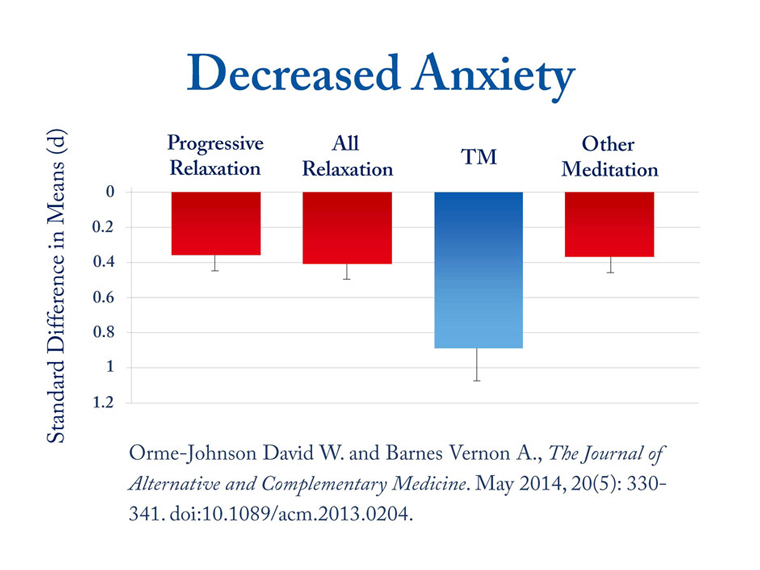
Decreased Anxiety
A comparative study, involving 1,295 subjects, found the TM technique
more effective than other approaches at reducing anxiety. The study also
found that TM practice significantly lowers anxiety among people with
the highest measures of trait anxiety. Journal of Alternative and
Complementary Medicine. May 2014, 20(5): 330-341.
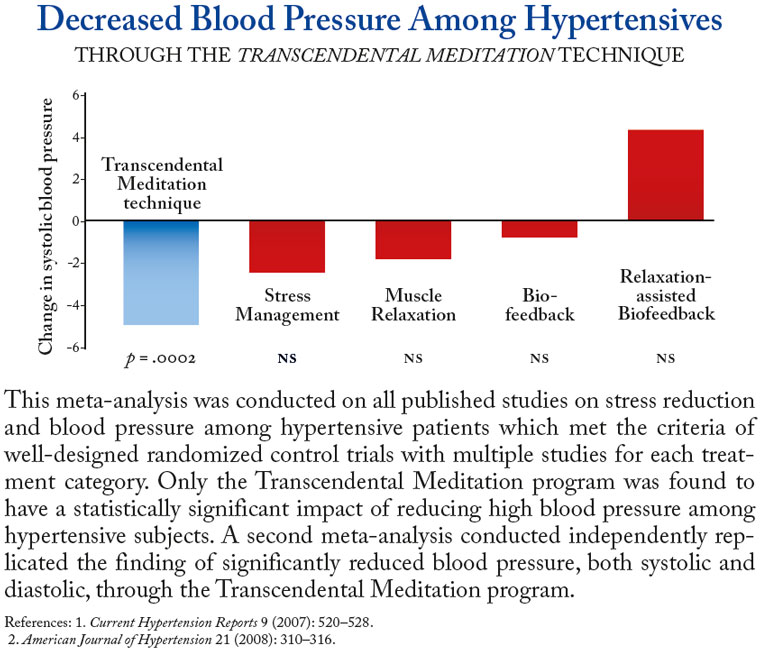
Normalization of High Blood Pressure
A meta-analysis conducted at the University of Kentucky considered a
wide variety of meditation practices and found TM to be the only
technique to significantly reduce high blood pressure. American Journal
of Hypertension 21 (3): 310-6, 2008.
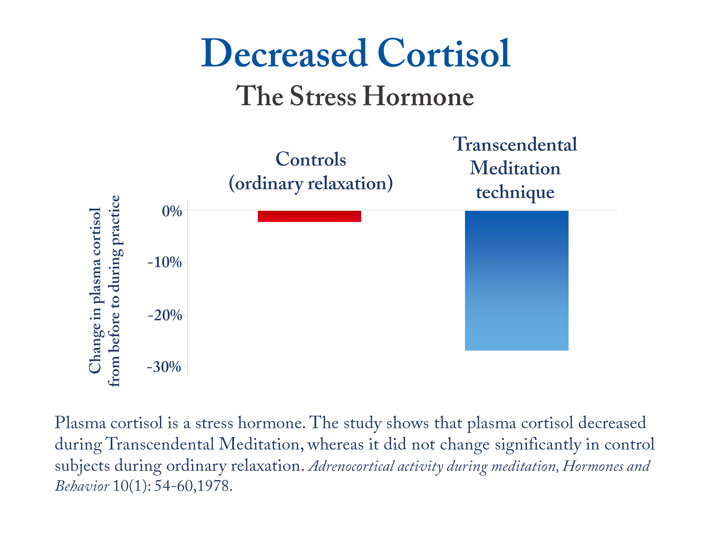
Biochemistry of Reduced Stress: Reduced Plasma Cortisol
Significantly decreased plasma levels of cortisol are seen during TM
practice, indicating reduced stress in the physiology. Hormones and
Behavior 10: 54–60, 1978.
Ideally,
the holiday season should be a time for good cheer. But for many, it
is also a time for loneliness, sadness, anxiety, depression, and family
conflict. Frequently people feel a profound sense of relief once the
holidays are over. It's a bit ironic that we should look forward to the
end of this season, when it could be a time for celebration,
thanksgiving, and family reunion. Here are eight things you can do to
make this a better holiday season for you and those around you:
1. De-commercialize your Holidays
For many families the "real" meaning of the
holidays (Thanksgiving, Christmas, etc...) gets buried in hi-tech
presents, credit card debt, shopping at malls, football games and
parties with lots of unhealthy food.
Many years ago my wife and I read an article by environmentalist Bill McKibben called The $100 Christmas.
The theme of the article was to de-commercialize the holidays by taking
the emphasis off of buying lots of gifts and redirecting energy towards
family, spending time with friends and rediscovering the meaning of the
holidays. McKibben suggested spending no more than $100 on gifts. So we
started making apple sauce and wreaths from wild grapevines. We spent
more time walking on quiet, snowy roads and less time navigating crowded
malls. I learned to play a few Christmas Carols on the piano and we
sang them while being warmed by the fire in our wood stove. My wife
baked cookies sweetened with Vermont maple syrup. We continued this
approach for the next few holiday seasons, making slight adaptations
each year. Each Christmas Day we walked around the woods and left bird
seed for the birds. The money we saved on gifts was given to charity and
we didn't have any horrifying credit card statements to review in
January (what a terrible way to start the new year).
Now that we have two daughters, we have been tugged
back in the direction of more shopping and rushing around. But those
years of simple holidays left their mark and we still make sure there's
time for holiday concerts, sledding and piano playing. So try rethinking
your holidays this year. Throw out some of your old traditions, if they
are no longer working for you, and start some new ones that give more
meaning and spirit to your celebration.
2. Keep Your Sugar Intake Low
Don't underestimate the role of two essential holiday
villians when it comes to depression, fatigue and irritability - alcohol
and sugar. Both are drugs and wreak havoc with your blood sugar system,
according to Kathleen DesMaisons, Ph.D., author of Potatoes Not Prozac.
You might get a quick "lift" from some Christmas cookies with green
icing. But it may not be long before you find yourself craving a cup of
coffee or a piece of pie just to help you feel a bit more alert.
Whatever goes up must come down - and that's particularly true of your
blood sugar. And as your blood sugar levels crash so does your energy
level and your spirits.
Psychiatrist William Philpott, M.D. tells of a woman
who was hospitalized because she was depressed and suicidal. He did a
six-hour glucose tolerance test for hypoglycemia. "One hour after giving
her glucose, I checked on her. Her blood sugar was high - 180 - and her
mood had drastically changed to euphoria. Two hours later, her blood
sugar had dropped to 40, and her mood had dropped right down with it.
There she was in the depths of depression again." If you struggle with
depression and fatigue during the holidays, this is the time to just say
no to holiday treats and champagne refills. Substitute healthy treats
and try drinks like sparkling apple cider or egg nog instead of liquor.
3. Get outside and exercise
Exercise can play an important role in lifting
your spirits and fighting off depression; in fact, it can be as
effective as medication with less side effects.
As an extra bonus, you can get some natural sunlight
while outside, which also helps to fight depression during winter
months. If you can't get outside much, find a gym or exercise class or
do some yoga at home. The holidays can be a busy time for many of us.
Make sure you continue to set aside some time to get your body and mind
moving in a healthy direction.
4. Stop trying to control your family members
Many of us use the holidays as a time for
reconnecting with our families including those family members who would
be doing so much better if they would just take our advice about how to
fix their lives.
Of course, they haven't in the past, but this
might just be the time they're ready to listen to us and "see the
light." As an alternative, why not leave our teacher/counselor hat in
the closet and just concentrate on being a loving
son/sister/cousin/parent. We can play this role quite well without ever
giving advice. And if someone else is trying to fix your life, well,
just listen, thank them for their concern, and perhaps ask them if
they'd like to go outside and help feed the birds.
5. Write a few personal holiday cards
If you send out a mass mailing of holiday cards with a
message that is just as appropriate for your cousin as for the Duke of
Edinburgh, consider a change of strategy. Forget efficiency and quantity
and just write a handful of cards with a personal message and either a
photo or a drawing by your five year old. If you don’t have a five year
old, try using crayons and draw something yourself. The basic idea is to
connect with people you want to connect with in a real and personal
way.
I have several friends who write beautiful, lengthy
messages in their cards. They have so much to say, they have to use the
back of the card and write in a circular style to navigate around the
copyright imprint. One of my friends nearly always includes a clipping
of some article from a magazine she thinks I’ll like to read. She’s
usually right. Fewer cards. Fewer stamps. Fewer dead trees. More
heartfelt communication.
6. Do something for others - not just your own family
Some of my most memorable and rewarding holiday experiences occurred
when I stepped outside of my own needs and problems and did something
helpful for others. On several Thanksgivings I served meals at a
homeless shelter. And I spent many Christmas mornings helping kids in a
children's hospital open gifts. Five years ago, I spent Christmas day
with my about-to-be-adopted daughter in Vietnam. In retrospect, I got
much more from these experiences than I gave. They were often the high
point of my holidays and helped me get some perspective on my own
difficulties and struggles. This holiday season will be challenging for
lots of families who have been hit with layoffs and lower income. What
could be more in line with the holiday spirit than to help a neighbor,
or friend, or even a perfect stranger?
7. Reflect on your Good Fortune
For many years I have used the time around Thanksgiving as a way of
reflecting on my life, particularly my good fortune. Each year I conduct
a 30 day self-reflection program that establishes a daily exercise in
self-reflection for the entire month of November. One of the exercises
involves making a list of 50 things about my life for which I am most
grateful. This process helps me to notice how the world is supporting me
so I don't just take these things for granted and inspires me to give
something back in return.
8. Focus on the present
Much of our emotional suffering occurs because our attention either
jumps to the future (worries about what will happen) or drifts to the
past (sadness about what already happened). If we can develop more skill
at keeping our attention present we are more likely to become fully
absorbed in what we are doing in the present moment. We may be helping
to cook some squash for dinner, or playing with our niece in the snow.
The present moment is our real life. Think about it – how much of our
emotional suffering comes from worrying about the future or complaining
about the past. Both are uncontrollable. If we fail to pay attention in
the present, we are more likely to struggle with psychological problems
while our real life passes us by.
Finally, don't expect to feel happy, grateful and
joyful throughout the holidays. It's not natural. What is natural is the
ebb and flow of feelings from one moment to the next. When those
inevitable moments of depression, fatigue or anxiety present themselves,
don't let them paralyze you or throw you off course. Just take them
along on your walk or let them accompany you while you bake some bread.
They'll move on, just as sure as winter will turn into spring.
The surest path to overcoming panic attacks is to train yourself to respond to panic in accepting and calming ways.
This article will show you a specific, simple, and powerful set of
tips for overcoming panic attacks. This material comes from my Panic Attacks Workbook.
As you read the steps described below, think about how they compare to what you usually do during a panic attack. The Panic Trick tells us that your gut instinct of how to respond to a panic attack will likely be to do something that makes the problem worse
rather than better. The path to overcoming panic attacks requires
responses that are quite different from what you usually do. If you keep
doing the same thing, you'll probably keep getting the same result. If
you seek anxiety relief, you need to look for different methods.
You can use these five steps to guide your responses during a panic
attack. The regular use of this approach will go a long way towards
your goal of overcoming panic attacks. I have adapted them, with some
modifications of my own, from Anxiety Disorders and Phobias: A Cognitive Perspective, an excellent professional text by Beck, Greenberg, and Emery.
The Five Steps of AWARE
The five steps to overcoming panic attacks are: Acknowledge & Accept Wait & Watch (and maybe, Work) Actions (to make myself more comfortable) Repeat End
Let's take a look at what each step entails.
Acknowledge & Accept
All progress starts here. This is the most important single step to overcoming panic attacks.
Acknowledge
Here I acknowledge the present reality, that I'm afraid and starting
to panic. I won't try to ignore it, or pretend it's not there. I won't
struggle to distract myself, tell myself to "stop thinking about it!",
or snap any rubber bands on my wrist.
I'm acknowledging simply
that I am afraid, not that I am in danger. The thought that I am in
danger is just another symptom of panic, not an important or useful
thought.
Accept
Here I accept the fact that I'm afraid at this moment. I don't fight the
feeling; ask God to take it away; blame myself, or anybody else. I
accept, as best I can, that I'm afraid in the same way I would accept a
headache. I don't like headaches, but I don't bang my head against the
wall in an effort to get rid of them, because that makes them worse.
Overcoming panic attacks begins with working with, not against, my panic
and anxiety symptoms.
How Can I Accept a Panic Attack?
What makes a panic attack acceptable (not desirable, but acceptable)
is that, while it feels awful and fills me with dread, it isn't
dangerous. It won't kill me or make me crazy. Someone pointing a gun at
me, that's not acceptable. I might get hurt or killed. If someone points
a gun at me, I have to do whatever I can to change that: run, hide,
fight, yell, bribe, or beg, because the consequence of being shot is so
terrible that I must try to avoid it.
On the other hand - a
policeman giving me a ticket, even if I don't deserve it, I can live
with that, and can hopefully keep my temper in check so I don't make
things worse for myself.
Accepting the symptoms, not resisting, is a powerful step to overcoming panic attacks.
What Can a Panic Attack Do to Me?
It makes me feel afraid, that's what a panic attack does. And, if I'm
having a panic attack, I'm already there! I'm already experiencing the worst that will happen. I just need to ride it out. That's the surest path to overcoming panic attacks.
Why
should I accept a panic attack? Because the more I resist panic, the
worse it gets. The more I develop the habit of acceptance, the more
progress I make toward my goal of overcoming panic attacks.
That's Acknowledge & Accept. How does that compare to what you usually do during a panic attack?
Wait & Watch (and maybe, Work)
Wait
What I mean by "Wait" is this: don't just do something, stand there.
It's similar to the suggestion "count to ten before you get mad".
One
of the hallmarks of a panic attack is that it temporarily robs you of
your ability to think, remember, and concentrate. This step will buy you
a little time to regain those abilities before you take any action.
When
you react before you have a chance to think straight, what do you do?
If you're like most people, you probably flee, or struggle. You do
things that actually make it worse. This is what people mean when they
say things like "I know I'm doing it to myself" and the harder I try, the worse it gets.
Jumping into action too quickly is a big obstacle to overcoming panic attacks.
So,
even though you have a powerful urge to leave, postpone that decision
for a little bit. Don't tell yourself you CAN'T leave - keep that option
open so you don't feel trapped - but put off the decision about whether
or not to leave. Stay in the situation. You don't need to run away to
get relief. Let relief come to you.
Watch
Use the occasion to observe how the panic works, and how you respond to it. The best way to do this is to fill out a panic diary.
The diary is a questionnaire which helps you notice important aspects
of a panic attack, so you can respond more effectively over time. Feel
free to download and reproduce it for your own personal use. You can
also download a set of instructions.
My
patients often report that just filling out a diary helps them to calm
down. How does this work? It's not that they're distracted from the
subject of panic, because the diary questions are all about panic. It
helps you get a little distance from your emotions. It works because,
while you complete a diary, you're in the role of an observer, rather
than feeling like a victim.
The best way to use the diary is to fill it out during
the attack, rather than after. If you're in a situation where writing
is impractical, perhaps while driving a car, you can: use a digital
recorder; have your support person read the questions to you and record
your answers; or pull over for a few minutes to write.
What About "Work"?
If you're in a relatively passive situation during the panic attack -
a passenger in a vehicle, getting your hair cut, or waiting in a
waiting room - "Wait & Watch" is all you need. If you're in a more
active role - driving a car or giving a presentation - then you also
need to attend to the "Work" of conducting that activity. Do "Wait &
Watch", but also remain engaged in your task.
That's "Wait & Watch (and maybe, Work)". How does that compare to what you usually do during a panic attack?
Actions (to make myself more comfortable)
At this point, you've already gone through the two most important steps to overcoming panic attacks.
These steps, and all the steps necessary to overcome panic disorder and phobia, are covered in much more detail in my Panic Attacks Workbook.
What's Your Job During an Attack?
It's not your job to bring the panic attack to an end; that will happen no matter what you do.
Your job now is to see if you can make yourself a little more comfortable, while you wait for the attack to end.
Here are a few techniques that my patients have found particularly useful in overcoming panic attacks.
Belly Breathing
Regardless of what else you do, do belly breathing.
It's also known as diaphragmatic breathing, but I think "belly
breathing" is more descriptive. Many people think they know how to do
deep breathing, but don't do it correctly, so they don't get good
results. A good belly breathing technique is a very powerful tool in the
work of overcoming panic attacks!
How to Talk to Yourself
Talk to yourself (silently!) about what is happening, and what you
need to do. One question my patients find very helpful is this: is it Danger or Discomfort? Some of the other responses my patients like include the following:
1. Fine, let's have an attack! It's a good chance to practice my coping techniques.
2. Answer your "what if...?" fears by saying "So what? I'll get afraid, then calm down again."
3. It's okay to be afraid.
Get Involved in the Present
People don't panic in the present. People panic when they imagine
something bad happening to them in the future or in the past. This is
why your panic attacks are almost always accompanied by some "what
if...?" thought. The reason you say "what if...?" is because what you fear is not actually happening!
Get
back into the activity you were engaged in prior to the attack, and
become involved with the people and objects around you. If you're in a
store, resume shopping, reading labels, comparing prices, asking
questions, etc. It will move you closer to your goal of overcoming panic
attacks when you bring your focus and energy back to the present
environment. By this I mean, work with what is around you.
Work with Your Body
Identify, and relax, the parts of your body that get most tense
during a panic attack. This typically involves first tensing, and then
relaxing, the muscles of your jaw, neck, shoulders, back and legs. Do
not allow yourself to stand rigid, muscles tensed, and holding your
breath. That just makes you feel worse! If you feel like you "can't move
a muscle", start with just one finger!
That's "Actions (to make myself more comfortable)". How does that compare with what you usually do during a panic attack?
Repeat
This step is here because you might start feeling better, then feel
another wave of panic. Your first reaction might then be to think "Oh
No, it didn't work!". The Repeat step is here to remind you that it's OK
if that happens. Just take it from the top again. It's not
unusual or dangerous. You may go through several cycles, and you just
need to repeat the AWARE steps again, as often as you need.
How does that compare with what you usually do?
End
This is here to remind you that your panic attack will end; that all
panic attacks end; that they end regardless of how you respond; that
it's not your job to make the attack end; and that your only job is to
make yourself as comfortable as possible while waiting for the attack to
end.
Have these statements been true for you? Don't take my word for it. Review your own history of panic attacks and see.
And
maybe the next time you panic, when you notice yourself thinking, once
again, "Will this ever end?", you'll find yourself answering, "YES!"
Overcoming Panic Attacks
Want a copy of my Panic Attacks Workbook? It'll take you through the
steps, from A to Z, of how to handle panic attacks in ways that lead
them to fade away, as well as how to overcome the phobias and avoidance
that usually accompany panic.
Anxiety and depression are two of the most common mental health
concerns in our society. They are often experienced as a complex set of
emotional and functional challenges.
The science of mind-body
medicine helps us understand the ongoing connection between the mind and
body and see how anxiety and depression may be triggered by a variety
of factors. These can include nutritional, psychological, physical, emotional, environmental, social, and spiritual
factors, as well as genetic tendencies or brain disease. While we often
hear about a biochemical cause, meaning that certain chemicals in the
brain called neurotransmitters are out of balance, it is not clear if
the level of neurotransmitters is the actual cause of anxiety and
depression, or simply a symptom that a person is anxious or depressed.
Anxiety
and depression are not the same, but they often occur together. It is
not uncommon for people with depression to experience anxiety and people
with anxiety to become depressed. There is also overlap in some of the
treatments, so it is beneficial to learn about both conditions.
Depression
Depression
is a common disorder, affecting over 350 million people worldwide. It
is a disabling condition that adversely affects a person's family, work,
or school life; sleeping and eating
habits; and general health. In the United States, the incidence of
depression has increased every year in the past century, and now,
according to the Centers for Disease Control, one out of ten people
report experiencing a depressive episode.
Depression is
typically characterized by low energy and mood, low self-esteem, and
loss of interest or pleasure in normally enjoyable activities. Symptoms
include:
Sleep disorders (too much or too little)
Shifts in appetite and weight (too much or too little)
Irritability or anxiety
Chronic physical symptoms, including pain, gastrointestinal disturbances, headaches, etc.
Loss of energy and fatigue
Feelings of persistent sadness, guilt, hopelessness, or loss of self-worth
Thinking difficulties, such as memory loss, challenges concentrating or making decisions
Thoughts of death or suicide
Some more facts about depression:
Women are 70% more likely than men to experience depression in their lifetime.
Men
and women experience depression differently—while women tend to
experience sadness and guilt, men often feel restless or angry and are
more likely to turn to alcohol and drugs to cope.
Only 50% of
people actively seek conventional treatment for depression, although a
majority of people do find some relief through treatment.
Depression causes unnecessary suffering and is a risk factor for suicide.
Women
and adults between the ages of 45 and 64 are most likely to meet the
criteria for major depression; however, over 3% of youth ages 13-18 have
also experienced a debilitating depressive episode.
Please share your thoughts so we can improve this website!
Anxiety
Anxiety may be a normal reaction to stress,
and it can serve as a prompt to deal with difficult situations.
However, when anxiety becomes excessive, it may fall under the
classification of an anxiety disorder. The Anxiety and Depression
Association of America estimates that almost one out of five people
suffer from an anxiety disorder, making it the most common mental
disorder in the United States.
Anxiety disorder is characterized
by emotional, physical, and behavioral symptoms that create an
unpleasant feeling that is typically described as uneasiness, fear, or
worry. The worry is frequently accompanied by physical symptoms,
especially fatigue, headaches,
muscle tension, muscle aches, difficulty swallowing, trembling,
twitching, irritability, sweating, and hot flashes. Emotional symptoms
include fear, racing thoughts, and a feeling of impending doom. People
suffering from anxiety often withdraw and seek to avoid people or
certain places.
While generalized anxiety disorder is the most
common, there are other anxiety disorders, including
obsessive-compulsive disorder, panic disorder, phobias, and
post-traumatic stress disorder.
Using an Integrated Approach
The recommendations in this article take an integrative mental health approach, which incorporates health-promoting lifestyle changes; evidence-based integrative therapies and healing practices; and mainstream interventions, including psychosocial therapies and the judicious use of medication. We cover each of these areas in detail--click the links or see the menu on the left at the top of this page.
The
relatively new field of integrative mental health is a holistic model
that provides a useful perspective on brain health and the treatment of
depression and anxiety. Integrative mental health looks at the physical,
psychological, social, and spiritual health of the individual and uses
evidence-based treatments from both traditional healing systems and
modern scientific practices. For more information, see The International Network of Integrative Mental Health.
Optimizing Brain Health
While
depression and anxiety are usually categorized as mental illnesses, we
find it more useful to think of them as disruptions in brain health,
which is directly related to the physical makeup and mechanisms of the
brain, as well as emotional and relational issues.
This
perspective highlights the need to take care of the brain, which, like
other organs in the body, is impacted by our lifestyle. As such, what we
eat, how we move, and the quality of our sleep impact the functioning of our brain. In addition, how we handle stress and other emotions, the quality of our relationships, and our sense of purpose all play a role in brain/mental health.
A
new concept of the brain is emerging. Instead of being a static organ
that doesn’t change after adolescence, the brain is now seen as having a
lifelong dynamic ability to change in response to its environment. Neuroplasticity
is the term used to explain the brain’s ability to change (from small
cellular changes to complete remapping) in response to new learning,
experience, or injury. This new understanding underlines the importance
of paying attention to our brain health and development. The brain as an
organ (like the heart) needs to experience a “brain-healthy” lifestyle
that includes the lifestyle guidelines in this website.
Working with Your Provider Team
When suffering from moderate to severe symptoms
of depression or anxiety, it is critical to have a working relationship
with a provider, or team of providers, who can help you choose your
treatment approach and evaluate its effectiveness. An integrative
approach includes psychosocial therapies and the judicious use of medication, as well as evidence-based complementary therapies and health-promoting lifestyle changes.
The providers may include a primary care physician, nurse practitioner,
psychotherapist, or other professional who is philosophically aligned
with you, as well as integrative therapy providers.
If you are
taking any oral natural supplements in combination with conventional
prescription medications, it is critical for both the prescriber and the
pharmacist to be aware which supplements you are taking.
If there
are any thoughts of or plans for suicide, a conventional therapist,
psychiatrist, or physician must be involved immediately, even if that
necessitates the use of emergency medicine services. If someone doesn’t
willingly request help, the family or other supportive members of that
person’s social sphere may need to intervene and engage services. The
risk for suicide often increases after early improvement induced by
either medications or supplements, as the individual finds more energy
and a sense of self-control. Support during this time of treatment is
critical.
Suggestions to Begin
Ways to start to take care of your brain (and the rest of your body).
1) Breathe………..slow exhalation helps relax the body
2) Move your body
3) Spend time in nature
4) Get regular, replenishing sleep
5) Spend time with supportive friends/family
6) Accept imperfection
7) Eat real/functional foods and drink lots of water
8) Meditate (sitting or moving) or take regular time for self-awareness practice
9) Practice forgiveness
10) Practice gratitude daily
Stressful times call for positive thinking. Maintaining a positive
attitude can mean the difference between triumphing over difficult
circumstances and succumbing to them.
The benefits of positive thinking are well known and worth considering.
However, it’s not always easy to stay positive when when fear and
uncertainty enter our lives.
Maintaining a positive outlook will help you survive hard times if and when they happen.
1. Knowing Yourself
Knowing yourself is the first step toward maintaining a positive
attitude. Are you thinking positively? Or has your thinking become
negative? Are you wishing you could maintain a more positive attitude?
Are your thoughts harmonious? Or are you always in the middle of uproar
and drama?
Perhaps it’s time to stop and take a personal inventory. Peace on a personal level is possible, but it must be cultivated.
2. The Law of Attraction
A powerful universal law operates anywhere and everywhere on this planet. It is called the Law of Attraction, and it means this:
Whatever you concentrate on, pay attention to, focus on or dwell on is
drawn to you, for better or worse. If you spend your time thinking on
negative or fearful things, your problems will enlarge. On the other
hand, if your thoughts are positive, hopeful and constructive, you will
draw positive things into your experience.
How much control do you have over this phenomenon? A lot! One key to
maintaining a positive attitude is to concentrate on being positive.
3. Positive Self-Talk
The best place to start is with yourself. Try as best you can to follow these principal guidelines:
-Be conscious of how you refer to yourself and your life. Substitute positive statements for doubtful or negative ones.
-Affirm your worthiness with positive statements, such as, “I am
healthy, I am strong, I am able to do everything I set my mind to.
Abundance and contentment are mine.â€
-Whenever a thought rises up that seems negative, substitute it with a peaceful, loving one.
With practice, you will feel your life changing. You’ll gradually
recognize yourself as a vital part of God’s plan, a worthy person able
to do and be far beyond what you’ve ever dreamed.
4. Positive Associations
One of the most important factors in maintaining a positive attitude is
associating with positive people. Who do you hang out with? As you
become increasingly able to maintain a positive attitude and thoughts,
you may find yourself gravitating toward more positive people and
avoiding folks who complain, blame and dramatize. This is a good sign!
5. How to Let Grace and Abundance Flow Through You
Your natural state as a human being is one of peace and grace, but the world has imposed its busyness and troubles on us all.
Relax and take frequent breaks throughout the day to concentrate on your
breathing, read inspirational writings, or just count your blessings.
Realize that peace and abundance are all around you. Open your heart to receive it. Your days will start to go better.
6. Some Techniques to Correcting Course Mid-Stream
Maintaining a positive attitude is easier said than done- at least at
first. It gets easier in time, and until it does, you will find negative
thoughts, fears, resentments and momentary confusion popping up to
invade your mind space.
Catch these thoughts mid-stream. Honor them as being mistaken, and let
them go. Resume a neutral or positive frame of mind. The following
techniques may help, but keep in mind that they take practice. The part
of you that is habitually negative, angry, discouraged will resist these
techniques at first. Do them anyway!
1. Focus on Your Breath
Conscious breathing brings you in tune and plugged into the present.
Fear and negative thought cannot exist in the now. Breath in and out
rhythmically, focusing on the rise and fall of your diaphragm. With
practice, this can be a powerful tool for resuming and holding yourself
in a positive, peaceful state.
2. Focus on the Word Love
Negativity flees when Love is on the scene. Breathing in love and
breathing out love will keep you focused and centered. If you find
yourself slipping into negativity, just return to Love.
3. Meditate for Several Short Periods Each Day
Sit or lie quietly, eyes closed with hands folded or held comfortably at
your sides. Let all tension go and just “be†where you are. If
thoughts creep in, let them go and resume an attitude of peace and
quiet. You may enjoy using a guided meditation tape when you’re
learning. In time you will look forward to these quiet times and miss
them when they are skipped.
7. The Benefits of Maintaining a Positive Attitude
What can maintaining a positive attitude do for you? Let us have a look:
First of all, the Law of Attraction will begin working for you in a more
positive way. You will attract more positive people, events and
situations in your life.
Second, you will be more relaxed and operate from the peace within. Your
response to life will come from a saner and less stressfull place, with
better outcomes. Your health will likely reflect your positive mental
outlook. People will ask you if you’re doing something different, and
you’ll be able to say, “Yes!â€.
Lastly, your heart will open toward others with compassion and
understanding. People will be attracted to you for the wisdom and
comfort they sense in your presence. You’ll find yourself being more
willing to do the right thing, say the right thing, at the right time.
8. Keeping a Positive Attitude Leads to a Positive Future
Cultivating positive thought patterns takes practice, but you’ve got
lots of time, and life gives you lots of opportunities to see things in a
better light. If you make a decision deep in your heart to think more
positively, practice the techniques outlined above about how to maintain
a positive attitude, and study the teachings of those who taught peace
and harmony as a way of life, you will eventually find yourself walking
in peace the better part of each day. There is no better way to live.
It's not very often we get to talk
about a revolution in understanding and treating depression and yet now
doctors are talking about "one of the strongest discoveries in
psychiatry for the last 20 years".
It is based around the idea
that some people are being betrayed by their fiercest protector. That
their immune system is altering their brain.
The illness exacts a heavy toll on 350 million people around the world, among them Hayley Mason, from Cambridgeshire:
"My
depression gets so bad that I can't leave the bed, I can't leave the
bedroom, I can't go downstairs and be with my partner and his kids.
The
30-year-old added: "I can't have the TV on, I can't have noise and
light, I have suicidal thoughts, I have self-harmed, I can't leave the
house, I can't drive.
"And just generally I am completely confined to my own home and everything else just feels too much."
Anti-depressant drugs and psychological treatments, like cognitive behavioural therapy, help the majority of people.
But
many don't respond to existing therapies and so some scientists are now
exploring a new frontier - whether the immune system could be causing
depression.
"I think we have to be quite radical," says Prof Ed Bullmore, the head of psychiatry at the University of Cambridge. He's at the forefront of this new approach: "Recent history is
telling us if we want to make therapeutic breakthroughs in an area which
remains incredibly important in terms of disability and suffering then
we've got to think differently."
The focus is on an errant immune system causing inflammation in the body and altering mood.
And Prof Bullmore argues that's something we can all relate to, if we just think back to the last time we had a cold or flu.
He
said: "Depression and inflammation often go hand in hand, if you have
flu, the immune system reacts to that, you become inflamed and very
often people find that their mood changes too.
"Their behaviour changes, they may become less sociable, more sleepy, more withdrawn.
"They
may begin to have some of the negative ways of thinking that are
characteristic of depression and all of that follows an infection."
It
is a subtle and yet significant shift in thinking. The argument is we
don't just feel sorry for ourselves when we are sick, but that the
chemicals involved in inflammation are directly affecting our mood.
Inflammation is part of the immune system's response to danger. It is
a hugely complicated process to prepare our body to fight off hostile
forces.
If inflammation is too low then an infection can get out of hand. If it is too high, it causes damage.
And
for some reason, about one-third of depressed patients have
consistently high levels of inflammation. Hayley is one of them: "I do
have raised inflammation markers, I think normal is under 0.7 and mine
is 40, it's coming up regularly in blood tests."
There is now a
patchwork quilt of evidence suggesting inflammation is more than
something you simply find in some depressed patients, but is actually
the cause of their disease. That the immune system can alter the
workings of the brain.
Joint pain
To explore this revolutionary new idea in depression, we visited an arthritis clinic at Glasgow Royal Infirmary.
It is perhaps an unexpected location, but it was in clinics like this that doctors noticed something unusual.
Rheumatoid arthritis is caused by the immune system attacking the
joints. And when patients were given precise anti-inflammatory drugs
that calmed down specific parts of the immune response, their mood
improved.
Prof Iain McInnes, a consultant rheumatologist, said:
"When we give these therapies we see a fairly rapid increase in a sense
of well-being, mood state improving quite remarkably often
disproportionately given the amount of inflammation we can see in their
joints and their skin."
It suggests the patients were not simply
feeling happier as they were in less pain, but that something more
profound was going on.
Prof McInnes added: "We scanned the brains
of people with rheumatoid arthritis, we then gave them a very specific
immune targeted therapy and then we imaged them again afterwards.
"What
we are starting to see when we give anti-inflammatory medicines is
quite remarkable changes in the neuro-chemical circuitry in the brain.
"The brain pathways involved in mediating depression were favourably changed in people who were given immune interventions."
One
possible explanation is that inflammatory chemicals enter the brain.
There they interrupt the production of serotonin - a key
neurotransmitter that's linked to mood.
To hear more we visited Carmine Pariante's laboratory at King's
College London. The professor of biological psychiatry has been piecing
together the evidence on inflammation and depression for 20 years.
He
told the BBC: "Nearly 30% to 40% of depressed patients have high levels
of inflammation and in these people we think it is part of the causal
process.
"The evidence supporting this idea is that high levels of
inflammation are present even if someone is not depressed, but is at
risk of becoming depressed.
"We know from studies that if you have
high levels of inflammation today you're at higher risk of becoming
depressed over the next weeks or months even if you are perfectly well."
He's shown that not only are depressed patients more likely to
have high levels of inflammation, but those with an overactive immune
system are also less likely to respond to anti-depressants.
This is a big deal because a third of patients don't get any benefit from drug treatments.
But there's something confusing here. The immune system responds to
infection and that doesn't seem to fit the usual story of depression.
Take Jennifer Streeting, a trainee midwife in London, who traces her mental health problems back to when she was 14.
"My
nana passed away and my mum had breast cancer and if you ask my
therapist now she puts it down to grief and not really dealing with that
at the time, I think there was just a lot going on."
Prof
Pariante argues it is actually these awful moments in our lives that
change our immune system, priming it to increase the risk of depression
years later.
He said: "We think the immune system is the key mechanism by which early life events produce this long-term effect.
"We
have some data showing adult individuals who have a history of early
life trauma, even if they have never been depressed, have an activated
immune system so they are in a state of risk."
The hope is that
drugs targeting the immune system will provide much needed treatments
for patients, particularly for those like Jennifer who seem to have
tried them all.
"I had sertraline, I had Prozac, there was another
one, I got started on citalopram, I was put on duloxetine, mirtazapine
as well. I was on three at one point."
She is now on a combination of drugs that seem to be working for her, but it has been a long journey.
"It is totally trial and error," said Prof Pariante.
He added: "We are not able to predict right from the beginning whether someone will respond.
"We
think by measuring inflammation in the blood we'll actually be able to
identify individuals that do require more complex, intensive
antidepressant treatment, maybe a combination of an antidepressant and
and anti-inflammatory."
Most of us have common
anti-inflammatories like ibuprofen at home, but doctors warn against
experimenting at home, while clinical trials are taking place to prove
whether this will work in patients.
The world's largest medical
research charity, the Wellcome Trust, has brought together universities
and the pharmaceutical industry.
The aim is to consolidate the
evidence to accelerate the field; ultimately they want to find a new
treatment for depression and develop a test to identify those who will
benefit.
Cambridge University's Prof Bullmore is leading the consortium. But we interviewed him at his other employer, GlaxoSmithKline.
The
company's immuno-inflammation laboratory is where scientists are
developing new molecules which they hope will become effective medicines
for inflammatory disorders.
That process will take more than a decade, but Prof Bullmore says there may already be a drug out there.
"One
of the exciting things about immunopsychiatry is that because of the
success of immunology in other areas of medicine there are already many
drugs that are far beyond this stage of development.
"They may
already be licensed or in late-stage clinical trials so the timeline
from start of work on that project to delivering a medicine that might
make a difference to patients could be much shorter."
Progress
Raiding
the cupboards is already showing signs of success. Those early clues in
arthritis mean the anti-inflammatory drug sirukumab is now being
trialled in depressed patients.
So are drugs targeting the immune system about to transform the treatment of depression?
Prof
Bullmore argues: "I don't think they are going to be a panacea, I don't
think we're talking about a scenario in future where every patient with
symptoms of depression is going to be offered an anti-inflammatory
drug.
"I don't think that makes sense and frankly that sort of
blockbuster one-size-fits-all approach to development of drugs for
psychiatry has not been helpful to us in the past.
"We have to take a more personalised or stratified approach, not everyone that is depressed is depressed for the same reason."
That will require a blood test to identify which patients will benefit from immune-based therapies.
Depression is a disease that affects hundreds of millions of people.
Even if anti-inflammatories help just a small proportion of them - that
would still be a huge number of patients. But if immunotherapy becomes a
success, its biggest impact may be on the way we think about the
disease, making people less likely to believe sufferers should just
"pull themselves together".
"I hate that phrase, if I could I would," says Jennifer.
She
adds: "Just as if someone had diabetes and their insulin levels weren't
working correctly, you wouldn't say, 'Oh snap out of it, stop having a
hypo.'"
Hayley feels the same: "If there was a way to say
depression was a physical problem I think it would make a massive
difference, I think people would treat depression as something that is
not made up and going on in the head.
"It would be seen as a genuine condition, it would validate a lot of people's feelings."
Prof
Pariante concludes: "It is groundbreaking because, for the first time,
we are demonstrating that depression is not only a disorder of the mind,
in fact it is not even only a disorder of the brain, it is a disorder
of the whole body."

 It
was 1998 when my brother Stephen began feeling unwell. He started
coughing a lot and needed a few pillows to sleep on. He was coughing a
lot of fluid up from his lungs and was very short of breath. We all
thought it was a bad chest infection but sadly within weeks everything
got much worse.
It
was 1998 when my brother Stephen began feeling unwell. He started
coughing a lot and needed a few pillows to sleep on. He was coughing a
lot of fluid up from his lungs and was very short of breath. We all
thought it was a bad chest infection but sadly within weeks everything
got much worse.